
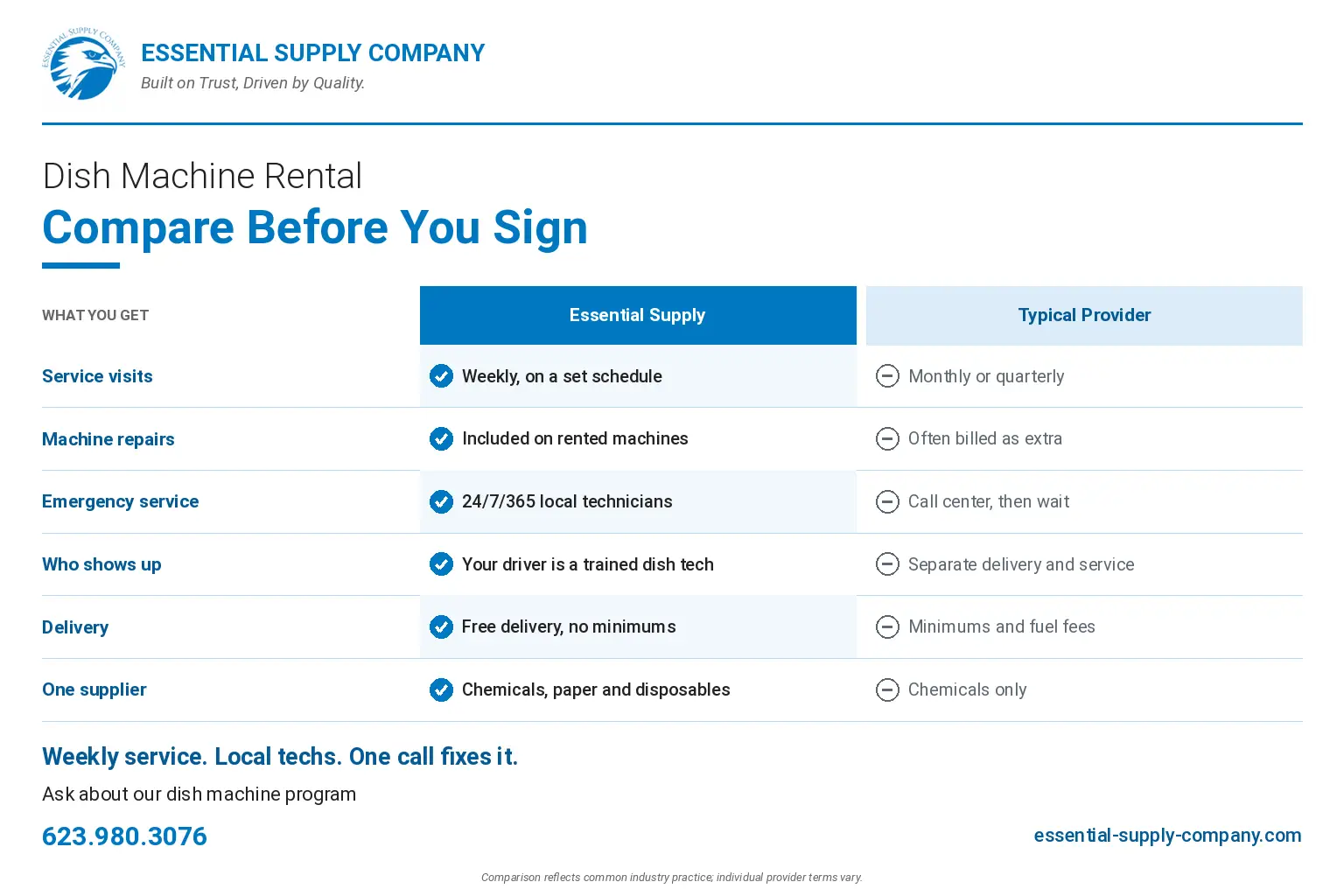
A dishmachine that stops during a busy meal period can back up the whole kitchen. Clean plates disappear, staff lose time, and the team starts washing by hand just to keep service moving. A useful dishmachine rental comparison looks beyond the monthly payment. It should show what happens when the machine needs attention, when chemicals run low, and when water quality affects results.
For restaurants, hotels, bars, caterers, schools, and facility kitchens, rental can make sense because it turns a major equipment need into an ongoing service program. But not every agreement provides the same level of support. The right choice depends on your volume, dish mix, staffing, utilities, and how much responsibility you want your supplier to handle.
Start Your Dishmachine Rental Comparison With Daily Demand
The first question is not, “What size machine can we fit?” It is, “What does this kitchen need to get through its busiest hour?” A quiet café, a full-service restaurant, and a banquet operation may all need commercial warewashing equipment, but they put very different demands on it.
Think about the number of racks or loads your team runs during peak periods, along with the types of items going through the machine. Glassware, sheet pans, pots, trays, and heavily soiled dinnerware affect both capacity and workflow. If a machine is too small, staff may rush loads or wait for clean wares. If it is larger than the operation needs, you may pay for capacity that sits unused while using more water, power, and chemicals than necessary.
Ask the supplier to assess the dish area, not just the equipment footprint. The placement of landing tables, shelving, drains, water connections, and staff movement all matter. A machine that technically fits can still create a bottleneck if employees have no room to sort, load, unload, and store clean wares safely and efficiently.
Compare throughput, not just machine type
Equipment categories are helpful, but they do not tell the whole story. A better comparison looks at the expected pace of your operation. Discuss your meal periods, event schedule, menu changes, and seasonal volume. A kitchen with a heavy weekend rush needs a different plan than one with steady all-day traffic.
The goal is not to buy more machine than you need. It is to give your dish team a dependable pace that keeps the kitchen supplied during service.
What Is Included When Something Goes Wrong?
Rental agreements often look similar on paper until the machine needs repair. This is where the service structure matters most. Ask who installs the equipment, who handles routine maintenance, how service requests are managed, and whether the supplier keeps local parts and technical support available.
Downtime is not only an equipment problem. It is an operating problem. A delayed repair can mean added labor, reduced capacity, and frustrated staff. A supplier should understand that your dishwasher is part of the line, just like refrigeration or cooking equipment. Clear communication and follow-up matter as much as the repair itself.
It also helps to know what is considered routine wear, what situations may fall outside the agreement, and how the supplier documents service work. These questions are not about finding fault. They help you set expectations before a busy night puts those expectations to the test.
For Arizona operators, local inventory and local technical support can be especially valuable. Heat, hard water, high-volume seasons, and a full dining room do not leave much room for a vague service plan.
Compare the Full Warewashing Program
A dishmachine does not work alone. It depends on the right chemistry, dispensing equipment, water conditions, staff habits, and scheduled attention. Comparing rental options without comparing these pieces can hide costs and create avoidable cleaning problems.
Start with chemicals. Ask whether the rental program includes compatible warewash chemicals and dispensing, how products are monitored, and how staff are trained on the system. The right chemical program supports clean results while helping the operation control usage. The wrong setup can lead to rewashing, spotting, residue, wasted product, and inconsistent results from one shift to the next.
Water quality deserves the same attention. Hard water can affect appearance, equipment performance, and chemical use. Water filtration service may be part of a stronger overall program, especially when your operation sees recurring spotting or scale concerns. The point is not to add services you do not need. It is to identify whether water is contributing to an ongoing dishroom issue before blaming the machine or the staff.
A supplier that handles equipment, chemicals, and water filtration can see the whole picture. That makes troubleshooting more direct. Instead of calling several vendors and sorting out who owns the problem, your team has one place to start.
Read the Agreement for Operational Flexibility
A rental arrangement should work with your business as it changes. Before you sign, review the agreement length, renewal process, equipment responsibilities, service coverage, and what happens if your volume changes. A new menu, expanded patio, catering contract, or busy hotel season can change dish demand quickly.
You should also ask how the supplier approaches installation and training. A good start matters. Staff need to understand the daily process, what normal operation looks like, and when to call for help. Training is not a one-time handoff. Turnover happens in hospitality, and new employees may need a clear refresher.
Do not overlook delivery and supply coordination. If dish chemicals, hand care, paper products, janitorial supplies, and foodservice disposables arrive through separate channels, it is easy to run short on something important. Combining recurring supplies with your dishmachine program can reduce purchase orders, simplify receiving, and give managers a clearer view of what the operation uses.
Rental Versus Purchase: The Practical Difference
Rental is often a strong fit when an operator wants predictable support, wants to avoid a large upfront equipment expense, or needs a program that includes maintenance and chemistry. It can also be a good option for new locations, changing concepts, or kitchens that would rather focus capital on other needs.
Purchase may fit an established operation that prefers to own its equipment and has a plan for maintenance, repairs, chemicals, and eventual replacement. Neither path is automatically better. The best option depends on how your business manages cash flow, risk, and service responsibility.
The mistake is comparing a rental payment to an equipment purchase price and stopping there. Include installation needs, ongoing chemicals, dispensing, water treatment, maintenance, repair exposure, staff time, and the cost of interrupted operations. Total operating cost is more useful than a single line item.
Questions Worth Asking Before You Commit
A supplier should be able to answer direct questions in plain language. Ask how the machine is matched to your volume, what installation includes, how routine service is handled, and what training your staff will receive. Ask how chemical delivery is managed and whether the supplier can support related needs such as paper, hand care, janitorial products, and to-go supplies.
It is also reasonable to ask for a review of your current spending. A price comparison can reveal where supply costs are drifting, especially when several vendors and invoices are involved. The value is not just lower pricing. It is knowing what you are buying, how often you use it, and where purchasing can be simplified.
Choose a Partner That Owns the Follow-Through
The strongest dishmachine rental program is not defined by the equipment alone. It is defined by the follow-through after installation: supplies delivered when you need them, chemistry managed correctly, staff supported, service concerns addressed, and someone checking that the program is still working for your kitchen.
Essential Supply Company brings dishmachine rental, repair, maintenance, warewash chemicals, water filtration, and recurring facility supplies together for Arizona commercial kitchens. Built on Trust, Driven by Quality. The right rental decision should give your dish team one less problem to carry into a busy shift.